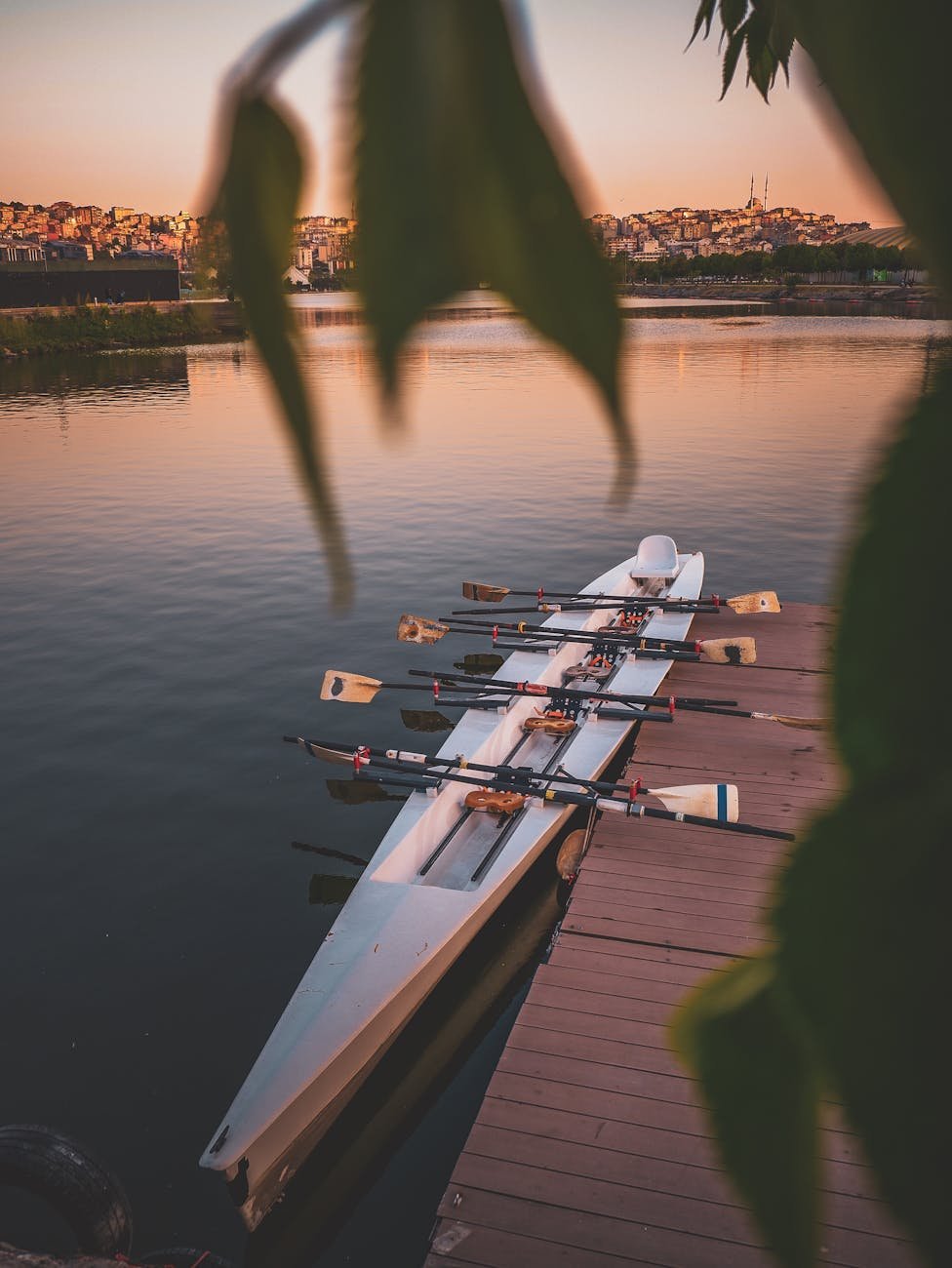
There is a particular quality of silence on the water just before a race begins. The crews are locked in their starting gates, blades flat on the surface, bodies coiled and still. Two thousand metres of flat water stretch ahead. Everything that has been trained, every early morning on the river, every weight session, every technical drill carried out in cold and wind and rain, compresses into this single suspended moment before the starter’s signal breaks it open.
Rowing is one of the oldest competitive sports in the world and one of the most physically demanding. It is also one of the most technically complex: a sport where brute strength without coordination is almost worthless, where the synchrony of eight athletes moving as a single organism can shave seconds off a time that individual power alone could never reach. It rewards patience, precision, and the willingness to suffer consistently over a very long time.
In 2026, as the sport looks toward the Los Angeles Olympic Games in 2028 with an expanded programme and a new discipline making its Olympic debut, rowing is at a genuinely interesting moment in its history. Here is everything you need to understand about it.
A Sport With Ancient Roots
The use of oars to propel a boat is as old as organised human movement on water. Records of rowing date back to ancient Egypt, where oar-propelled vessels appear in illustrations dating to around 1900 BCE. The ancient Greeks and Romans used rowing both for warfare and transport, and competitive racing between oarsmen is documented across multiple classical civilisations.
As a formalised competitive sport, rowing emerged in England in the seventeenth and early eighteenth centuries. Professional watermen on the River Thames raced for prize money and the entertainment of spectators on the riverbanks. The sport grew steadily, moving from professional competition into the universities and schools that would shape its culture for the next two centuries.
The Oxford-Cambridge University Boat Race, inaugurated in 1828, became one of the most celebrated fixtures in British sporting life and remains so today. By the middle of the nineteenth century, rowing clubs had established themselves across Britain, Europe, and North America. The sport arrived at the first modern Olympic Games in Athens in 1896, though rough seas forced the cancellation of the events that year. It has featured at every Olympic Games since.
The Fédération Internationale des Sociétés d’Aviron, known as FISA and now operating as World Rowing, was among the first international sports federations ever established. The first World Rowing Championships was held in Lucerne, Switzerland in 1962.
How Rowing Works
Understanding rowing begins with a distinction most people outside the sport do not know exists: the difference between sweep rowing and sculling.
In sweep rowing, each rower holds a single oar with both hands. The oar extends out over one side of the boat only. Sweep boats require even numbers of rowers to maintain balance, since the force must be distributed across both sides of the vessel.
In sculling, each rower holds two oars, one in each hand, with one extending over each side of the boat. A sculler works both sides simultaneously, which means a single sculler can row solo without any imbalance.
Both disciplines are raced over a standard course of 2,000 metres at international and Olympic level. Rowers sit with their backs to the direction of travel, which means they cross the finish line going backwards. This is not a quirk but a function of mechanics: the drive phase of the rowing stroke produces more power when the legs, back, and arms engage in sequence from a compressed starting position, which requires the rower to face away from the direction of travel.
The standard racing stroke breaks into four phases:
- The catch: the blade enters the water at the front of the stroke
- The drive: the power phase, as the legs push, the back opens, and the arms pull
- The finish: the blade exits the water at the end of the stroke
- The recovery: the rower slides forward on a moving seat back to the catch position
In a racing eight, all eight athletes perform this sequence in precise coordination, directed by a cox who steers the boat, calls the rhythm, and makes tactical decisions throughout the race.
The Boat Classes
Competitive rowing involves a wide range of boat classes, defined by the number of athletes, whether the discipline is sweep or sculling, and whether a coxswain is present.
The main Olympic boat classes are:
- Single scull (1x): one rower, two oars; the purest test of individual rowing ability
- Double scull (2x): two scullers; fast and technically demanding
- Quadruple scull (4x): four scullers; one of the most spectacular boat classes in the sport
- Coxless pair (2-): two sweep rowers without a cox; requires extraordinary technical partnership
- Coxless four (4-): four sweep rowers without a cox; a classic Olympic boat class
- Eight (8+): eight sweep rowers plus a coxswain; the largest and fastest boat class in the sport
Para rowing events are also contested at World Championships and Paralympic Games, with classifications based on the level of physical function available to the athlete.
The Physical Demands
Rowing makes demands on the body that are difficult to overstate and even more difficult to fully appreciate without having experienced them.
A 2,000-metre race at elite level lasts between approximately five and a half and seven minutes depending on the boat class and conditions. Each rower performs a full-body movement with every stroke, engaging the legs, core, back, and arms at maximum effort throughout. The physiological demand combines explosive power with sustained aerobic output in a way that few other sports require simultaneously.
Training for competitive rowing is comprehensive by any standard:
- Ergometer work (rowing machine) allows athletes to train at controlled intensities year-round, regardless of weather or water conditions
- On-water training develops the technical precision, balance, and coordination that no machine can replicate
- Strength and conditioning builds the leg power, back resilience, and shoulder stability that rowing demands
- Flexibility and mobility work protects the hips, lower back, and thoracic spine from the repetitive loading of the stroke
Elite rowers typically train twice daily during peak preparation periods, placing rowing among the highest-training-load Olympic sports.
Major Competitions
The international rowing calendar is structured around several key events.
The World Rowing Championships is the sport’s flagship annual event in non-Olympic years, held during the summer at venues rotated around the world. The 2025 edition was held in Shanghai, China, where the Netherlands topped the overall medal table ahead of Great Britain and China. Italy’s men’s quadruple sculls made history as the first Italian crew to be named Men’s Crew of the Year, and the Dutch women’s eight claimed their first-ever world championship title.
The Olympic Games remain the sport’s most prestigious event. At the Paris 2024 Olympics, fourteen events were contested across seven boat classes for both men and women, with 502 athletes competing at the Vaires-sur-Marne Nautical Stadium. Paris 2024 was the final Olympic Games to include lightweight rowing. At Los Angeles 2028, lightweight categories will be replaced by coastal rowing.
World Rowing Cups are a series of international regattas held during the competitive season, providing athletes with ranking opportunities and preparation outside the championship calendar.
The Henley Royal Regatta, held annually on the Thames at Henley-on-Thames, Oxfordshire, since 1839, is one of the oldest and most distinguished rowing events in the world. It operates independently of the World Rowing calendar and uses its own unique course and format, but remains one of the sport’s most celebrated occasions.
Coastal Rowing: The Newest Olympic Discipline
Coastal rowing is a discipline in which athletes race along a coastline using wider, flatter boats designed to handle open water and waves. Beach sprint rowing, the format set for Olympic debut, is contested over a total course of around 600 metres. It begins with athletes running down a beach into the water, rowing out around a buoy and back, then sprinting back up the beach to the finish line.
At Los Angeles 2028, coastal rowing will make its Olympic debut, replacing lightweight rowing. Competitive coastal rowing as an organised sport began in France in the 1980s, with the first World Championships in the endurance version held in Cannes in 2007. Beach sprint racing became a World Rowing discipline in 2015, with the first dedicated World Rowing Beach Sprint Finals taking place in 2019.
The Sport’s Greatest Champions
Rowing has produced some of the most decorated Olympic athletes of any sport.
British rower Sir Steve Redgrave is the only rower to have won five gold medals at five consecutive Olympic Games, from Los Angeles 1984 to Sydney 2000. His compatriot Matthew Pinsent won four Olympic gold medals. Among women, Romanian rowers Elisabeta Lipă and Georgeta Andrunache each hold the joint record for the most Olympic titles won by a female rower, with five gold medals apiece.
The national landscape of international rowing has shifted across different eras. The United States dominated Olympic rowing until around 1960. East Germany became the preeminent power through the 1970s and 1980s. More recently, Great Britain, Australia, New Zealand, the Netherlands, and Romania have competed consistently at the top of the international rankings.
Rowing as a Recreational and Club Sport
Beyond elite competition, rowing is a widely accessible participation sport with a large and active club culture across many countries.
Club rowing operates at every level, from complete beginners to masters competitors who race internationally in age-group categories. Many clubs welcome athletes with no prior experience and offer learn-to-row programmes that build fundamental technique before progressing toward club racing.
The health profile of recreational rowing is well regarded. The full-body nature of the stroke builds strength, cardiovascular fitness, and core stability simultaneously. Because there is no ground contact, joint loading is relatively gentle compared to running, making it suitable for a wide range of ages and physical conditions.
Indoor rowing using ergometers has also grown significantly as a standalone fitness practice. Online ranking systems and indoor rowing competitions attract serious competitors who train specifically for machine-based racing, in some cases without ever competing on water.
What Makes Rowing Different
Several things set rowing apart from most other competitive sports, and they are worth naming clearly.
The first is the combination of individual effort and collective precision it demands. In an eight, no single athlete can compensate for a weakness in another. The boat travels only as fast as the crew can work together, which means eight athletes must subordinate individual rhythm to collective timing across the full length of a race. Very few sports are this unforgiving about interdependence.
The second is the quiet culture of the sport. Rowing does not have the media profile of football or cycling. Its best athletes are largely unknown outside the rowing community despite producing physical performances that would command wide recognition in any other context. That relative obscurity has shaped the culture of the sport: serious, inward-focused, and deeply respectful of the work required.
The third is the landscape. Rowing takes place on water, and training on a river or lake at five in the morning, in changing light and weather, with the particular quality of stillness that moving water produces, is an experience that is genuinely difficult to replicate anywhere else. Many rowers describe the sensory dimension of the sport as a significant part of why they stay.
Looking Toward LA 2028
World Rowing’s 2025 Quadrennial Congress approved several significant changes, including the introduction of a Mixed Eight event at both the World Championships and Olympic Games, subject to IOC acceptance, and a new progression system designed to make competition more compelling. The Mixed Eight was introduced at the 2025 World Championships in Shanghai as a test event.
At Los Angeles 2028, the rowing events will return to the Marine Stadium in Long Beach, California, the same course used at the 1932 Olympic Games. The addition of coastal rowing and the Mixed Eight reflects a deliberate effort to broaden the sport’s appeal without changing what makes it exceptional.
For a sport that has been testing its athletes against still water and a fixed distance for centuries, the next chapter looks genuinely compelling.
Disclaimer: This article is intended for general informational purposes only. Competition formats, records, and governance structures are subject to change. Always verify current details with World Rowing and relevant national federations.