
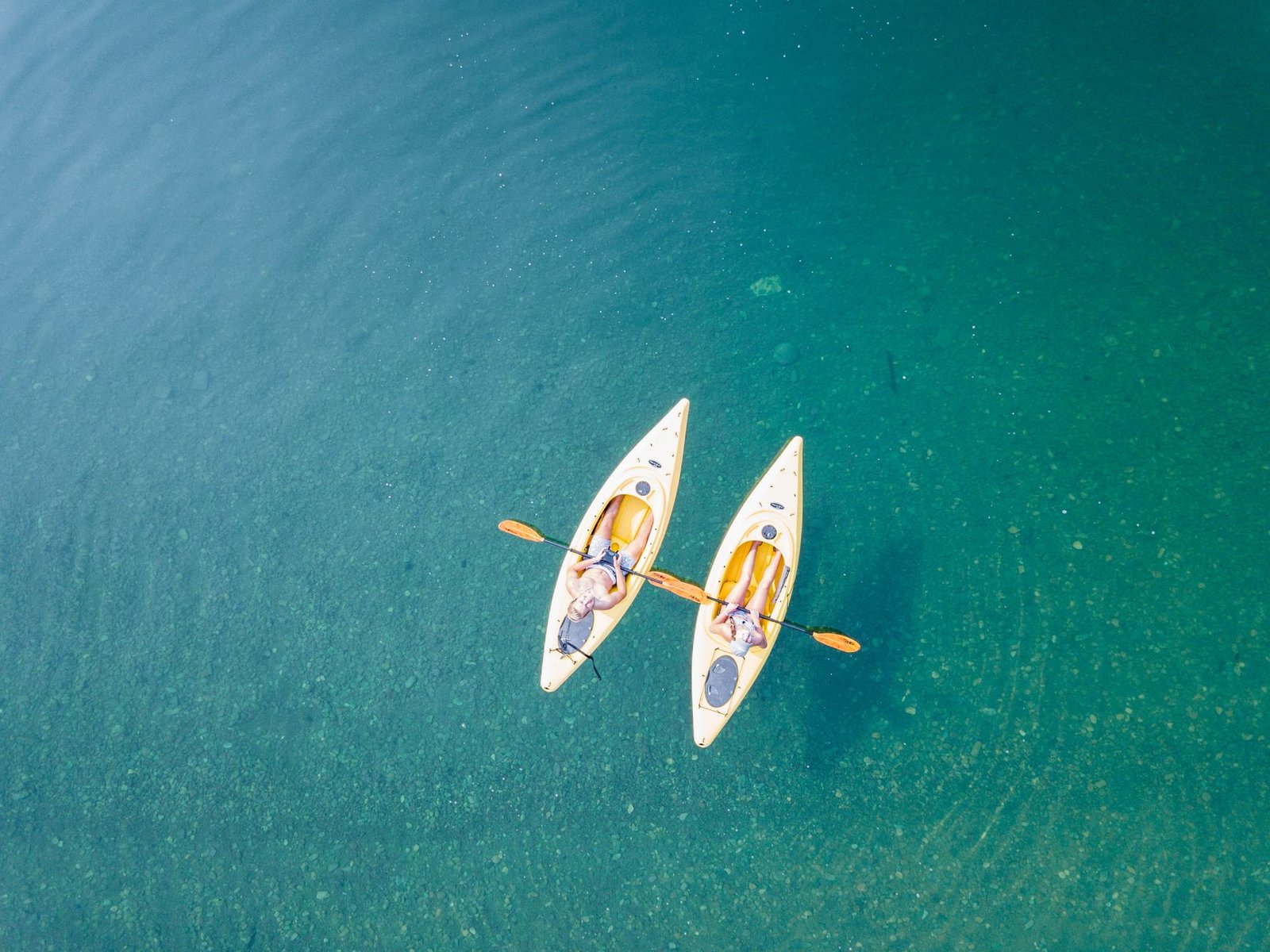
The kayak is one of humanity’s oldest inventions and one of its most elegant. A simple vessel, quiet enough to move through water without frightening prey, strong enough to survive brutal Arctic conditions, and small enough for a single person to carry and control. What began as a critical tool for hunters navigating frozen seas has become a global recreation available to anyone with access to water and a willingness to learn. The evolution of kayaking tells a story about human ingenuity, cultural adaptation, and our ongoing relationship with the natural world.
The Origins and Purpose
The kayak was developed by indigenous Arctic peoples, the Inuit, Yup’ik, and Aleut, at least 4,000 years ago, though the exact date of its first appearance remains unknown. These communities inhabited the harsh Arctic regions where survival depended on access to marine resources. The kayak itself was built from what was available locally: frames of driftwood in the western Arctic and whalebone in the east, both lashed together with animal sinew and covered with stretched and stitched hides from seals, sea lions, or caribou. The entire structure was waterproofed with animal fat.
What made the kayak revolutionary was its design. It was small, weighing as little as 30 to 50 pounds, allowing hunters to propel it silently across water. It was maneuverable, responsive to the subtle weight shifts and paddle strokes of a single person. And it was personal: each kayak was custom-built by the man who would paddle it, sized to his own measurements and weight. A kayak was crafted with the paddler’s body as the unit of measure: length often extended to about three times his arm span, width was roughly his hips plus two fists, and the depth matched a clenched fist plus an extended thumb. This bespoke approach meant that European explorers later encountered repeated frustration when trying to replicate the exact dimensions of a kayak they had observed: without the original owner’s exact proportions, the boat would feel either tippy or sluggish in the water.
The word itself comes from the Inuit term “qajaq,” meaning “man’s boat” or “hunter’s boat.” This was not a poetic label but a practical one. The kayak was designed specifically for hunting seals, fish, whales, and other Arctic marine life. It was a tool of survival, and mastery of the kayak meant competence as a provider and a community member.
To use a kayak safely required more than just the boat. Hunters wore a tuilik, a form-fitting waterproof jacket made from seal skins or the intestines of larger sea mammals. The tuilik sealed around the paddler’s face, wrists, and the opening of the kayak itself, keeping water out even if the boat capsized. The trapped air inside provided buoyancy, allowing a skilled paddler to roll the kayak back upright, a maneuver called the Eskimo roll, without ever leaving the boat.
The Design and Its Variations
Kayaks were built to suit the waters their users inhabited. In regions where severe storms were common and wind could build dangerous waves, kayaks needed to be stable and durable. In places where pack ice blocked wind and prevented large waves, kayaks could be built narrow and low, prioritising speed and silence. This adaptability is why traditional kayaks showed considerable regional variation.
The Aleut people of the Bering Sea and Aleutian Islands built a distinctive kayak known as the baidarka or iqyax, featuring bifurcated bows designed to cut through rough ocean swells with greater speed and stability. The West Greenland kayak showed fewer curves but a more angular hull, with gunwales that rose to sharp points at bow and stern. The East Greenland style resembled its western cousin but fit the paddler more snugly and featured steeper angles that enhanced maneuverability in tighter waters. These were not incidental differences: they were the result of centuries of experience, knowledge passed down through oral tradition and refined by each generation based on what worked and what did not.
European Encounter and Transformation
Europeans first encountered kayaks in the 17th century through Arctic exploration. They were struck by the boat’s ingenious design and durability. By the 18th century, kayaks had begun to appear in European museums as objects of cultural study. It was not until the 19th century, however, that Europeans began using kayaks for sport rather than survival.
German explorer and businessman Johann Klepper played a pivotal role in introducing kayaks to European recreational paddlers. After encountering a folding kayak in 1905, he began manufacturing versions that combined the traditional skin-on-frame design with innovation: wooden or later aluminum frames covered in rubberised canvas that could be folded for transport. This made kayaking accessible to Europeans who wanted to paddle but lacked the harsh Arctic conditions that gave the original kayak its purpose. By this innovation, the kayak transformed from a survival necessity into a recreational pursuit.
Modern Kayaking: Materials and Disciplines
The materials and purposes of kayaking have changed dramatically in the past century. Fiberglass replaced wood and canvas as the dominant construction material in the 1950s. Polyethylene plastics became standard by the 1980s. Modern kayaks are now made from composite materials including Kevlar, offering choices between weight, durability, cost, and water characteristics. The spray deck, a waterproof synthetic skirt that fits around the cockpit, has replaced the traditional tuilik, providing similar protection but greater ease of exit.
Contemporary kayaking encompasses multiple disciplines, each with its own specialized boats and techniques. Sea kayaking mirrors the original purpose of Arctic kayaking: long-distance travel and expedition-style paddling in open water, often covering significant distances over days or weeks. Whitewater kayaking tests paddlers against rapids and falls, demanding different boat designs entirely—typically shorter, wider, and more buoyant than sea kayaks. Recreational or touring kayaking is gentler, focused on exploring lakes, rivers, and coastal areas at a leisure pace, often used for wildlife observation, photography, or simple physical activity.
Kayak fishing has become a thriving specialisation, with kayaks rigged with rod holders, fish finders, and storage specific to anglers’ needs. Surfing with kayaks, or kayak surfing, emerged in the 1960s and adapts whitewater techniques to ocean waves, requiring short, maneuverable craft designed for speed and quick direction changes. Greenland-style paddling remains a competitive discipline, with festivals and workshops celebrating the traditional techniques and boat designs that have endured for thousands of years.
The Olympic Legacy and Competitive Kayaking
Kayaking entered the Olympic Games at Berlin in 1936 as a competitive sport, a remarkable achievement for a discipline that had transitioned from survival tool to recreation in little more than a century. The Olympic programme includes sprint kayaking, which tests speed over fixed distances, and slalom kayaking, which tests precision and control through hanging gates on a whitewater course. These events have remained fixtures in the Olympic calendar for nearly 90 years, testament to kayaking’s global appeal and competitive structure.
Kayaking Today
Modern kayaking is accessible in ways that were impossible even a generation ago. Kayaks can be rented affordably at most water recreation facilities. Production methods allow boats to be made in a wide range of sizes, colours, and designs. Materials are durable and do not require the regular oiling and maintenance that traditional seal-skin kayaks demanded. Safety equipment including life jackets approved by coast guards meets rigorous standards.
At the same time, traditional kayaking has experienced a renaissance. Organisations like Qajaq USA promote Greenland-style paddling and maintain the techniques and boat designs of Arctic traditions. Workshops and festivals across North America and Europe celebrate skin-on-frame kayak construction and the gentle, meditative approach to paddling that characterises traditional practice. Some builders continue to construct kayaks in this ancient style, using modern materials like canvas-covered frames but retaining the principles of design and technique that have worked for over a thousand years.
Getting Started: Practical Information for Beginners
For someone considering kayaking, the most important first step is finding instruction from qualified professionals. Most water recreation facilities offer beginner classes that teach basic paddling technique, safety procedures, and water awareness. These courses typically cost between 50 and 150 dollars and take two to four hours.
Regarding equipment, newcomers have several options. Renting a kayak from an outfitter costs between 20 and 50 dollars per day for a recreational kayak, making it possible to try the sport before investing in equipment. Buying a new recreational kayak suitable for beginners ranges from 300 to 1,000 dollars depending on the boat’s quality and materials. Basic paddles cost 75 to 200 dollars. The most important safety equipment is a Coast Guard-approved personal flotation device (PFD), which costs 40 to 150 dollars and should be worn at all times on the water.
Regarding what to wear, appropriate clothing depends on water temperature. In warm conditions, quick-drying shorts and a moisture-wicking shirt are sufficient. In cold water, a neoprene wetsuit or dry suit is essential to maintain body temperature. Water shoes with grip soles help with launching and landing. A hat provides sun protection, and sunscreen prevents burns.
The physical benefits of kayaking include improved cardiovascular fitness from sustained paddling, strengthened core and upper body muscles, increased flexibility in the hips and shoulders, and low-impact movement suitable for people with joint concerns. Most recreational paddlers find that regular kayaking improves balance, coordination, and mental wellbeing.
Why Kayaking Endures
The kayak endures because it solves a fundamental human challenge: how to move across water with minimal resources, maximum efficiency, and complete control. In its original form, it allowed Arctic hunters to survive. In its modern forms, it gives contemporary paddlers access to waters and experiences that would otherwise be unreachable. Whether someone is paddling a sleek plastic whitewater kayak down a mountain river, a stable recreational kayak across a calm lake, or a traditionally styled Greenland kayak through open ocean, they are using a technology that has been refined through centuries of hands-on experience.
The kayak is also enduring proof that innovation does not require complexity. A thin hull, a double-bladed paddle, and the paddler’s own weight and balance: that is all that is needed. Everything else is refinement. And that simplicity is part of why the kayak, in all its modern and traditional variations, remains one of the most beloved watercraft in the world.
Disclaimer: This article is intended for general informational purposes only. Kayaking involves water and carries inherent risks. Always wear appropriate safety equipment, including a Coast Guard-approved personal flotation device, and seek instruction from qualified professionals before attempting kayaking.


