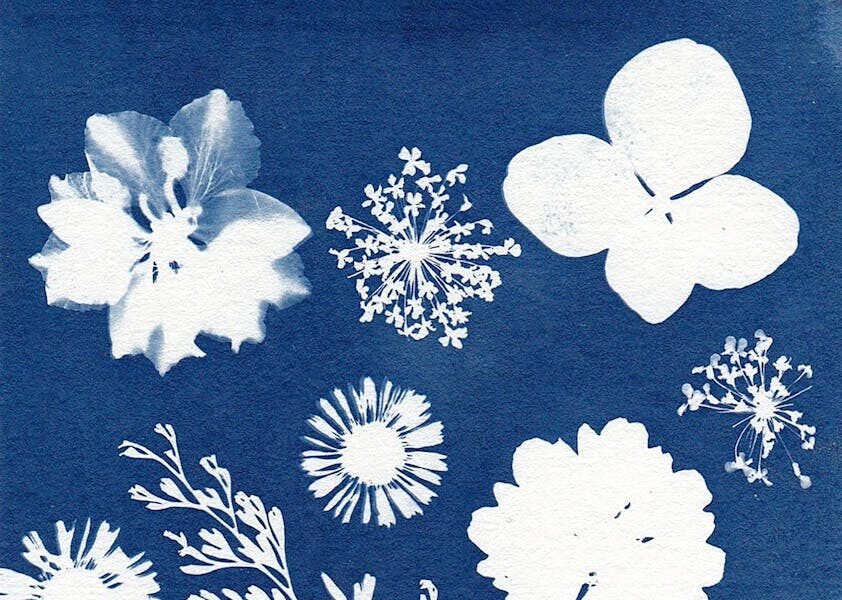
Ever considered exploring the art of cyanotype printing? There is something quietly extraordinary about placing a fern frond on a sheet of treated paper, carrying it into the sun for a few minutes, and watching a rich, deep blue image emerge after a rinse in cold water. No darkroom. No expensive equipment. Just chemistry, light, and whatever you choose to place on the surface.
Cyanotype is one of the oldest photographic processes still widely practised, and it is enjoying a genuine resurgence among artists, photographers, textile makers, and curious beginners who want a hands-on creative practice with a low barrier to entry. This guide covers the full range: from choosing your first materials all the way through to the advanced techniques that keep experienced practitioners returning to the process year after year.
A Brief History Worth Knowing
Cyanotype was invented in 1842 by Sir John Herschel, an English mathematician, astronomer, and chemist. While investigating the behaviour of light on iron-based compounds, Herschel discovered that two specific iron salts, when combined and exposed to ultraviolet light, would produce a stable, vivid blue pigment known as Prussian blue. The process required no darkroom, no silver salts, and almost no specialist equipment, making it unlike any photographic technique of its time.
One of its earliest and most celebrated practitioners was Anna Atkins, an English botanist and photographer who used the process to document algae and fern specimens in extraordinary detail. Between 1843 and 1853, she produced a series of volumes containing hundreds of cyanotype contact prints, each one made by laying specimens directly onto sensitised paper and exposing them to sunlight. Her series “Photographs of British Algae: Cyanotype Impressions” is now recognised as the first photographically illustrated book ever published, predating Henry Fox Talbot’s “The Pencil of Nature” despite his own claims to the distinction. Her work remains visually stunning almost two centuries later.
Cyanotype later became the standard method for reproducing architectural and engineering drawings, and that practical application is exactly why technical plans came to be known as blueprints. The engineering era has long passed, but the artistic possibilities of the process have only deepened since.
What You Need to Get Started
Cyanotype’s accessibility is one of its defining qualities. The materials cost very little, they are straightforward to source, and the process requires no dedicated darkroom or professional studio.
For your first session (the simplest route):
These items are all you need to make your first print. Pre-coated paper handles all the chemistry for you.
- Pre-coated cyanotype paper, available from art supply shops, photography retailers, and online stores
- Flat objects to print with: leaves, flowers, feathers, lace, ferns, cut paper, or keys
- A sheet of clear glass or acrylic to press objects flat during exposure
- A tray of cold water for rinsing
- Direct sunlight or a UV exposure lamp
When you are ready to coat your own surfaces:
Mixing your own sensitiser gives you control over surface type, texture, size, and chemical concentration.
- Ferric ammonium citrate (Solution A)
- Potassium ferricyanide (Solution B)
- Distilled water for mixing both solutions
- A foam brush or soft hake brush for applying the sensitiser evenly
- Cold-press watercolour paper of at least 200gsm for durability through wet processing
- A shaded indoor space for coating and drying
- A dedicated wash tray kept separate from anything used for food or drink
Both chemicals are sold individually or as combined kits through photography and printmaking suppliers. They are prepared as two separate solutions in distilled water, stored in dark bottles, and only combined immediately before you are ready to coat.
The Core Process, Step by Step
The fundamental workflow is the same whether you are printing for the first time or the hundredth. Working through each step with care makes the difference between a satisfying result and a frustrating one.
Step 1: Prepare Your Sensitiser
If you are coating your own paper, mix your two solutions separately in advance and allow them to rest for several hours, ideally overnight, before use. When ready to coat, combine equal parts of Solution A and Solution B in a small, clean container. From this point, work in subdued indoor light. Even household bulbs contain trace UV, which can begin fogging your surface if you work too slowly or leave it exposed.
Apply the combined solution to your paper or fabric using a foam brush in smooth, overlapping strokes. Thin, even coverage produces better results than a heavy coat. The sensitiser works at a chemical level, not like a surface pigment, so more is not better. Hang the coated paper or lay it flat to dry in a fully dark space. Paper typically needs around an hour; fabric may require a little longer.
Step 2: Arrange Your Composition
Once your surface is completely dry, move to a shaded outdoor space or a dimly lit indoor area to arrange your objects. Work with some deliberateness: once you carry the setup into UV light, the clock starts. Lay your objects on the sensitised surface, then place your sheet of glass firmly on top to press everything as flat as possible.
Good contact between your objects and the surface produces clean, sharp-edged silhouettes. Poor contact, where objects are curved or slightly raised, produces soft, diffused edges that often look accidental rather than intentional. This is the most common cause of disappointing first prints.
Step 3: Expose to UV Light
Carry your setup into direct sunlight or position it under a UV lamp. The sensitised surface will begin shifting colour almost immediately, moving from its original yellow-green coating towards an increasingly pale, bleached-out appearance. A fully exposed print looks nearly colourless or very faint. That colour loss is the signal that exposure is complete.
On a bright, clear day, exposure can be as short as a few minutes. Overcast conditions extend the time considerably, and heavily overcast skies can make consistent results difficult to predict. If you are working indoors with a UV lamp, follow the manufacturer’s guidance on working distance, as output strength varies significantly between units.
Step 4: Rinse and Develop
Bring your setup back out of the light, remove your objects, and immediately place the print into a tray of cold water. As the print rinses, the areas blocked from light will release as a pale yellow liquid, while the areas that were exposed to UV will deepen and oxidise into the characteristic Prussian blue. Cold water produces the most saturated, richest blues. Adding a small amount of hydrogen peroxide to the rinse water speeds up the oxidation process and can intensify the final colour noticeably.
Rinse the print until the water runs completely clear, then hang it to dry in a well-ventilated space. Peg at one corner rather than two so that any remaining liquid drains away cleanly without pooling along an edge. Flatten the dried print under heavy books if it has buckled during the wash.
Surfaces Beyond Paper
Standard paper is the natural starting point, but cyanotype solution bonds well to almost any surface with an open, absorbent texture. Trying different surfaces is one of the most compelling parts of developing a longer-term practice.
The most commonly used alternatives include:
- Natural fabrics: Untreated cotton, linen, and silk all accept the sensitiser reliably. Synthetic fabrics and anything treated with stain-resistant or fire-retardant finishes will repel the solution. Finished cyanotype fabric pieces should be sealed before laundering, as alkaline detergents cause the image to fade.
- Watercolour and printmaking papers: Heavy cold-press watercolour paper produces exceptional results, with deep contrast and minimal buckling through the wash stage. Papers made with a high cotton fibre content tend to hold the blues more richly than those produced primarily from wood pulp.
- Wood, stone, and unglazed ceramic: These surfaces require thinner application and longer exposure times. Unglazed, bisque-fired ceramic tiles produce particularly striking results and can be sealed with a clear matte varnish to preserve the image permanently.
- Found objects and unusual materials: Artists working at an advanced level have printed on eggshell, bone, recycled packaging, old book pages, and glass. Results on unconventional surfaces are unpredictable, which is precisely what makes experimenting with them worthwhile.
Toning: Changing the Colour of Your Prints
The deep Prussian blue of a standard cyanotype does not have to be the final result. Toning changes the colour of a finished print using organic liquids, opening up a range of warm and earthy alternatives.
The most accessible toning liquids are:
- Black tea: Strong brewed tea shifts the blue towards warm brown tones and gives prints a vintage, aged quality.
- Coffee: Brewed coffee produces a similar shift but darker, moving towards rich sepia or near-black tones depending on how long the print is soaked.
- Red wine: Wine with a high tannin content shifts the blue towards a reddish-brown, though results vary significantly depending on the wine and its tannin level.
- Vinegar or lemon juice: A small amount added to the rinse water during development deepens and intensifies the blue before it fully oxidises, rather than changing the colour after the fact.
Toning a finished print requires a bleaching step first. The dried print is briefly immersed in a very dilute alkaline solution, such as weak household bleach or washing soda dissolved in water, until the blue largely disappears. The toning liquid is then applied to recolour the image. Bleaching requires care, as the paper can be damaged if the solution is too strong or the print is left too long. Practise on prints you are willing to lose before attempting it on a favourite piece.
The Wet Cyanotype Technique
For practitioners looking to push beyond the standard process, wet cyanotype opens up a completely different set of creative possibilities. Rather than exposing a dry sensitised surface, you lightly mist the coated paper with water before placing your objects and exposing it to light. Working on a wet surface allows the chemistry to interact with additional materials in ways that are simply not possible on a dry print.
Common additions used in wet cyanotype work include:
- Salt crystals, which create halo effects and textured bursts around objects
- Turmeric and paprika, which leave warm staining that reacts with the iron compounds
- Diluted vinegar or lemon juice, which intensifies blues and sharpens contrast in specific areas
- Soap bubbles, which leave delicate circular impressions in the emulsion
- Coffee grounds and tea leaves, which create organic texturing across the surface
The wet process is inherently less predictable than the dry method. Exposure times are often longer, and developing the prints requires more patience. The colour shifts are more dramatic, the tonal range is wider, and the results carry a quality that looks genuinely handmade rather than mechanically precise. That spontaneity is the whole point. What might look like a flaw on a dry print often becomes the most compelling element of a wet one.
Chemical Safety
Cyanotype is generally regarded as one of the safer photographic processes, but the chemicals involved still require sensible handling.
Keep these precautions in mind at every session:
- Wear disposable gloves when mixing or applying the sensitiser. Both iron compounds can cause skin sensitivities with repeated exposure, even if no reaction occurs in early sessions.
- Work in a space with good ventilation. The chemicals do not produce hazardous fumes under normal conditions, but a ventilated space is always good practice when working with any photographic chemistry.
- Keep all chemicals, coated papers, and rinse trays well away from food preparation surfaces, food, and drink.
- Never pour rinse water down a kitchen sink. Use a utility sink or an outdoor drain. The yellow waste water from the rinse stage is the spent iron compound washing from the paper.
- Store solutions in clearly labelled dark glass or opaque plastic bottles, away from children and pets.
- Dispose of spent chemicals in accordance with local guidelines for photographic or chemical waste.
Tips for Better Results
These practical points apply at every level of experience and make a consistent difference to print quality.
- Keep everything cold. Cold sensitiser, cold rinse water, and cool working conditions all contribute to deeper, more saturated blues. Some experienced printers add ice to their rinse trays.
- Apply the sensitiser thinly. A heavy coat does not improve results and often produces streaking or uneven tones.
- Choose glass over plastic for contact printing. UV light travels through glass more cleanly and evenly than through acrylic or perspex.
- Prepare your coated paper the evening before a printing session and store it overnight in a light-proof bag or between the pages of a book. Paper that has had time to rest after coating tends to produce more consistent results.
- Keep notes on every print. Record the exposure time, weather or lamp conditions, the surface used, and any variations you introduced. This single habit accelerates improvement faster than any other approach.
Storing and Displaying Your Prints
Cyanotype prints are genuinely durable when stored and displayed correctly. The Prussian blue compound is stable in normal indoor conditions, but certain factors will cause it to degrade over time.
Follow these guidelines to protect your work:
- Store prints in polyester sleeves or archival, acid-free materials. Alkaline paper envelopes or card folders will cause the image to shift towards yellow and eventually fade.
- Keep prints away from prolonged direct sunlight in display. Like any light-sensitive artwork, extended UV exposure will cause gradual fading over time.
- Avoid humid storage environments. Moisture accelerates the chemical degradation of the iron compound.
- Frame displayed prints behind glass using UV-filtering conservation glass if they are intended for long-term display. Avoid using alkaline mount boards directly against the surface of the print.
A well-made cyanotype, properly stored, can remain stable and visually vibrant for many decades.
Going Further
Cyanotype is a practice with a genuinely low ceiling to start and almost no ceiling to grow. A first print can be made in an afternoon with a kit costing very little. A print made by an artist who has worked with the process for years still carries marks of unpredictability that keep the practice alive and interesting.
The natural next steps after mastering the basics are digital negatives for photographic imagery, toning experiments, wet technique work, and printing on unconventional surfaces. Beyond those, practitioners have combined cyanotype with embroidery, gold leaf, eco-printing, and mixed media painting. The chemistry is old. What you do with it is entirely your own.
Start with pre-coated paper, a handful of leaves or objects from around your home, and whatever natural light the day offers. Your first print will be imperfect in small ways. Make the next one anyway.
Disclaimer: This article is intended for general informational and educational purposes only. Always read and follow the safety guidance provided by your chemical supplier, handle all photographic chemistry responsibly, and keep all materials away from children and food preparation areas.