There is a particular kind of travel that stays with you long after you go home. Vietnam does that to most people. They arrive for the landscapes and the food. They leave carrying something harder to name: the feeling of a country that has endured more than most and arrived, on the other side, full of life.
Vietnam stretches more than 1,600 kilometres from north to south along the eastern edge of the Indochina Peninsula. It is narrow but enormously varied. Misty limestone mountains rise in the far north. Ancient imperial cities sit in the centre. A tropical coastline runs almost the full length of the country. In the south, the Mekong Delta spreads flat and watery to the sea.
A Country Built on Endurance
Vietnam’s first recorded state, Van Lang, was founded in the seventh century BCE along the Red River Valley in the north. A thousand years of Chinese rule followed. It ended in 938 CE, when a Vietnamese lord named Ngo Quyen defeated a Chinese fleet on the Bach Dang River using a brilliant strategy of iron-tipped wooden stakes planted in the riverbed. That victory remains one of the defining moments in Vietnamese history.
By the early nineteenth century, the country had unified under the Nguyen Dynasty, with its capital at Hue. That unity did not last. France began seizing the south in 1859 and had absorbed the entire country into French Indochina by 1887. The colonial period transformed the economy, built roads and railways to serve French interests, and left a visible architectural legacy in city streets today.
The French were driven out in 1954 after a decisive defeat at Dien Bien Phu. The country was then divided at the seventeenth parallel. What followed was one of the defining conflicts of the twentieth century. American forces withdrew in 1973. The country reunified under Hanoi’s government in 1975. The Socialist Republic of Vietnam was formally proclaimed in 1976.
The years after reunification were difficult. The country was isolated, its infrastructure damaged, its people exhausted. The turning point came in 1986 with a set of economic reforms known as Doi Moi. These loosened state control, encouraged private enterprise, and opened Vietnam to foreign investment. The transformation since then has been extraordinary. Vietnam is now one of Southeast Asia’s most dynamic economies.
Three Vietnams in One Country
Most travelers move through Vietnam as three distinct regions, each with its own character, climate, and rhythm.
The North
Hanoi, the capital, is a city of lakes, leafy streets, and a dense old quarter where roads were historically named for the trades practiced on them. Silk Street, Tin Street, Paper Street: the names still hold, even if the goods have changed. The city moves quickly but carries its past carefully.
Key things to do in Hanoi:
- Visit the Temple of Literature, built in 1070 as Vietnam’s first university, dedicated to Confucius and Vietnamese scholars
- Watch a water puppet show, a performance tradition dating back to the eleventh century, performed on water to the sound of live musicians
- Eat pho at a street stall at seven in the morning
Beyond Hanoi, the scenery becomes dramatic. Ha Long Bay, a UNESCO World Heritage Site first inscribed in 1994, covers approximately 1,553 square kilometres of the Gulf of Tonkin and contains roughly 1,969 limestone islands and islets rising from emerald water. An overnight cruise is the best way to experience it. You can kayak through sea caves, visit floating fishing villages, and watch mist settle over the karsts at dusk.
Further north, in the mountains near the Chinese border, the terraced rice fields around Sapa and the raw scenery of Ha Giang attract travelers who want something less visited and more demanding.
Central Vietnam
Hue was the imperial capital of the Nguyen Dynasty. It holds the remains of a vast walled citadel, inside which the emperor once had his own private city. The complex sustained significant damage during the 1968 Tet Offensive and is still being restored. Exploring it is one of the most layered historical experiences Vietnam offers.
The food in and around Hue is exceptional and distinct from the rest of the country:
- Bun bo Hue: a rich, spiced beef noodle broth, heavier and more complex than the pho of the north
- Banh khoai: a crispy rice crepe filled with shrimp, pork, and bean sprouts
- Com hen: a small clam rice dish eaten for breakfast, intensely flavoured and deeply local
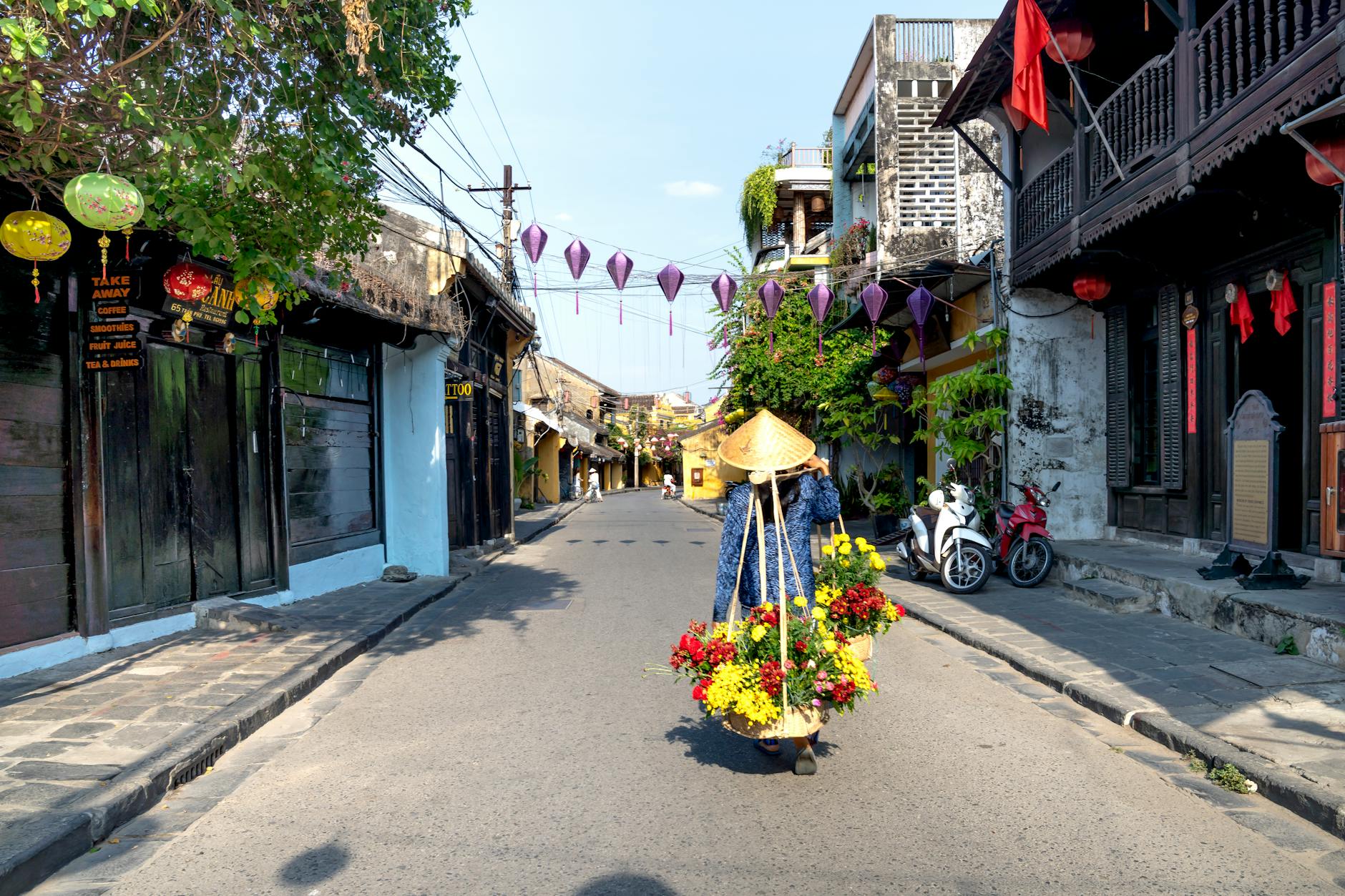
An hour south, Hoi An is one of the best-preserved trading ports in Southeast Asia. Its ancient quarter, also a UNESCO World Heritage Site (inscribed in 1999), has barely changed in outline since the seventeenth century, when merchants arrived from China, Japan, and the Netherlands. The streets are narrow, the buildings low and lantern-hung, and the atmosphere is genuinely unhurried.
Hoi An is also among the best places in Vietnam to have clothes made. The tailoring tradition runs deep, the quality is consistently high, and the prices are very reasonable. Beaches just outside town are long, clean, and far quieter than the resort strips further south.
The South
Ho Chi Minh City, which most Vietnamese still call Saigon, is a city of extraordinary energy. Two-wheeled traffic fills every lane. Street food vendors start before dawn. Rooftop bars overlook a skyline that has changed dramatically in recent decades. The city carries its French colonial past in its architecture while living entirely in the present.
Must-visit sites in Saigon and the surrounding area:
- The War Remnants Museum: documents the conflict from the Vietnamese perspective with great directness; one of the most visited and most affecting sites in the country
- The Cu Chi Tunnels: an extensive underground network built and used during the war; located about an hour outside the city
- Ben Thanh Market: a busy, central market good for street food, fresh produce, and local goods
Further south, the Mekong Delta is a landscape of slow rivers, floating markets, coconut plantations, and water everywhere. Traveling through it by boat, stopping at small workshops that make rice paper, coconut candy, and honey, offers a view of daily life that has changed far less than the cities have.
The Food Is the Journey
Vietnamese cooking is built on balance. Fresh herbs, light broths, rice noodles, and proteins that are grilled or steamed rather than heavy with oil. The flavours are clean and bright. The portions are generous. The prices are low.
Dishes every traveler should try:
- Pho: a rice noodle soup built on a slow-cooked bone broth, served with fresh herbs, chilli, and lime; available everywhere, morning to night
- Banh mi: a crispy baguette, adapted from the French, filled with pickled vegetables, herbs, chilli, and your choice of pork, chicken, or egg; one of the great street foods of the world
- Bun cha: grilled pork patties served in a sweet and salty dipping broth with vermicelli noodles and fresh herbs; a Hanoi staple
- Com tam: broken rice with grilled pork, a fried egg, and pickles; the default lunch of Ho Chi Minh City
- Cao lau: thick noodles served with pork, greens, and crispy rice crackers; a Hoi An specialty with a preparation method unlike anything else in the country
Vietnamese coffee is in a category of its own. The traditional style drips slowly through a small metal filter into a glass of sweetened condensed milk. In Hanoi, a version made with whipped egg yolk and sugar has become one of the most talked-about drinks in the country. It is richer than it sounds and worth trying.
Practical Matters for Travelers
Getting There and Around
Vietnam has three main international airports:
- Noi Bai Airport (HAN): serves Hanoi in the north
- Da Nang Airport (DAD): serves central Vietnam
- Tan Son Nhat Airport (SGN): serves Ho Chi Minh City in the south
Domestic flights between these cities are frequent and affordable. The overnight train between Hanoi and Da Nang or Hue is a comfortable and scenic alternative for travelers with more time. Open-tour buses connect most tourist destinations at very low cost.
Visas and Entry
Most nationalities can apply for a Vietnam e-visa valid for up to 90 days through the official government portal before departure. Some countries qualify for visa-free entry under bilateral agreements. Entry requirements do change, so always confirm the current rules with official sources well before you travel.
Money and Connectivity
Vietnam uses the Vietnamese dong. Cash is still widely used, particularly in smaller towns and local markets. ATMs are easy to find in cities and larger towns. Mobile data SIM cards are inexpensive and available at all major airports on arrival.
When to Go
The best time to visit varies by region:
- Northern Vietnam: October to April offers cooler, clearer weather; summer is hot and humid
- Central Vietnam: February to August is most reliably dry and sunny; October and November bring heavy rains
- Southern Vietnam: December to April is the dry season; the south can be visited year-round
Respecting Local Culture
Vietnam rewards travelers who take a little time to understand local customs. A few simple habits go a long way.
- Remove your shoes before entering homes, temples, and some traditional restaurants. Look for a row of shoes at the entrance as your signal.
- Dress modestly at temples and pagodas. Shoulders and knees should be covered.
- Accept food and drink when offered by a host. Refusing can be taken as impolite.
- Keep calm in all situations. Raising your voice or showing frustration in public causes loss of face for everyone involved and rarely helps.
- Bargain gently at markets, but do so with good humour. Aggressive negotiating is considered rude.
- Learn a few words. Even a simple xin chao (hello) or cam on (thank you) is met with warmth.
Why Vietnam Now
Vietnam is not a secret. It has been one of Southeast Asia’s most visited countries for years. But it still feels genuine in a way that more heavily developed destinations sometimes do not. A morning market still runs the way it has for generations. A temple festival still draws the whole neighbourhood.
The country has modernised quickly without losing what makes it worth the journey. The food, the history, the landscapes, the people: they all deliver. Most travelers who visit once start thinking about when they can come back before they have even left.
Disclaimer: This article is intended for general informational and travel inspiration purposes only. Visa requirements, entry conditions, and travel advisories change regularly. Always verify current requirements with the relevant embassy or official government sources before booking travel.